Steyr Landmaschinentechnik AG (Steyr Tractor) was sold to Case Corporation in 1996 and renamed Case Steyr Landmaschinentechnik (and is part of CNH since 1999). 4 Automobile production remained with Steyr-Daimler-Puch Fahrzeugtechnik (SFT) until Magna International acquired a majority holding, in 1998, and in 2001–2002 SFT was absorbed fully. Finding the Blue Book value of your new and used firearms, including pistols, rifles, shotguns, airguns, and blackpowder guns is easy with the number one source of gun pricing. This site provides values and information on firearms in a convenient online pricing guide format, and allows you to find out what your used guns are worth. The first 20,000 M1894 rifles (serial numbers 1 - 20000) were produced in Steyr, Austria by the Austrian Arms Company. The next 10,000 (serial numbers 20001 - 30000) were produced in Norway at the Kongsberg Arms Factory, with the following 9,000 (serial numbers 30001 - 39000) being made in Steyr.
(Redirected from Steyr Mannlicher)
| Steyr Mannlicher AG | |
| GmbH | |
| Industry | Firearms |
|---|---|
| Predecessor | Steyr-Daimler-Puch |
| Founded | 16 April 1864; 156 years ago |
| Founder | Josef Werndl |
| Headquarters | Sankt Peter in der Au, Amstetten District, Lower Austria , |
Area served | worldwide |
| Products | Pistols Rifles Submachine gun Machine gun Combination guns Grenade launchers |
| Subsidiaries | Steyr Arms Inc. |
| Website | www.steyr-arms.com |
Steyr Mannlicher logo
Steyr Arms (German pronunciation: [ˈʃtaɪ̯ɐ](listen)) is a firearms manufacturer based in Sankt Peter in der Au, Austria. Originally part of Steyr-Daimler-Puch, it became independent when the conglomerate was broken up in 1989.[1] Prior to 1 January 2019, the company was named Steyr Mannlicher AG (German pronunciation: [ˈʃtaɪ̯ɐ ˈmanlɪçɐ ˈʔaːˈɡeː]).
History[edit]
The company logo 1869–1926
Share of the Oesterreichischen Waffenfabriks-Gesellschaft, issued February 1920
Steyr has been on the 'iron road' to the nearby Erzberg mine since the days of the StyrianOtakar dukes and their Babenberg successors in the 12th and 13th century, and has been known as an industrial site for forging weapons.[citation needed] The privilege of iron and steel production, particularly for knives, was renewed by the Habsburg duke Albert of Austria in 1287. After the Thirty Years' War, thousands of muskets, pistols, and carbines were produced annually for the Habsburg Imperial Army.[citation needed]
In 1821, Leopold Werndl (1797–1855), a blacksmith in Steyr, began manufacturing iron parts for weapons. After his father's death, 24-year-old Josef Werndl (1831–1889) took over his factory. On April 16, 1864, he founded the 'Josef und Franz Werndl & Comp. Waffenfabrik und Sägemühle in Oberletten' (Josef and Franz Werndl & Partners Weapons Factory and Sawmill in Oberletten), from which later emerged the 'Österreichische Waffenfabriksgesellschaft' (ŒWG, Austrian Arms-Manufacturing Company), a stock company (AG) since 1869, of which the Steyr Mannlicher firearm production was a part.
Werndl's cooperation with engineer Ferdinand Mannlicher (1848–1904), who had patented an advanced repeating rifle in use by the Austro-Hungarian Army, made ŒWG one of the largest weapon manufacturers in Europe. First applied in 1890, the Mannlicher M1901, and the Steyr-Hahn M1912 became milestones in auto-loading pistol technology.[citation needed] At the beginning of World War I, with more than 15,000 employees, production output was 4,000 weapons per day.
Aftermath of World War I[edit]
After the war, weapons production in Steyr was all but entirely prohibited according to the 1919 Treaty of Saint-Germain, and the company faced bankruptcy. To survive, the ŒWG converted their machinery to concentrate on producing Steyr automobiles under chief designers Hans Ledwinka and Ferdinand Porsche, as well as bicycles (colloquially called Waffenräder ('weapon bicycles')). In 1926 the company changed its name to 'Steyr-Werke'. The production of Steyr Mannlicher weapons continued in cooperation with Patronenfabrik Solothurn AG at Zuchwil in neutral Switzerland.
World War II[edit]
After the Austrian Anschluss to Nazi Germany in 1938, the Steyr factories were incorporated into the Reichswerke Hermann Göring industrial conglomerate and the outbreak of World War II provided a brief revival in weapons production. Like many other companies, Steyr Mannlicher relied on forced labour, employing from the Steyr-Münichholz subcamp of KZ Mauthausen.
1950s[edit]
During the 1950s the Mannlicher–Schönauer full stock rifle experienced a renaissance.[citation needed] Simultaneously, the re-emergence of the Austrian Armed Forces in the Second Republic was the base for new military weapons production.
The AUG[edit]
In the 1970s, Steyr developed an innovative assault rifle, the StG 77. A bullpup design, the StG 77 extensively utilized synthetic materials, and integrated fixed optics. The export version became the Steyr AUG—Armee Universal Gewehr ('Universal Army Rifle'), eventually used by the armed forces of over 24 countries.[citation needed] It has been prominently featured in films such as Octopussy, Commando, and Die Hard and Surviving The Game.[2]
Products[edit]
- Assault Rifle
- ACR experimental assault rifle
- STM556[3]
- Battle Rifle

- Rifles
- M1886 – bolt-action rifle
- M1888 – bolt-action rifle
- M1890 – bolt-action rifle
- M1895 – bolt-action rifle
- Dutch Mannlicher M.95 – bolt-action rifle
- Mannlicher–Schönauer – bolt-action rifle
- Steyr Model 1912 Mauser - bolt-action rifle
- Steyr SSG 69 – sniper rifle
- Steyr Scout – scout sniper rifle
- Steyr SSG 04 – sniper rifle
- Steyr SSG 08 – sniper rifle
- Steyr HS .50 – anti-materiel rifle
- Steyr IWS 2000 – 15.2 mm anti-materiel rifle
- Submachine guns
- MPi 69 (Variant: Steyr MPi 81)
- Pistols
- M1894 (1894–?)
- M1901 (1901–1903)
- M.7 (1908–1913)
- M1912 (1912–1945)
- GB (1970s–1980s)
- M Series (1999–present)
Date codes[edit]
Steyr Date Code Chart
Steyr pistols are marked with a three-digit date code on the slide just forward of the ejection port.The first letter represents the month of manufacture.The second and third letters represent the last two digits of the year of manufacture.
In this example, the date code 'BOY' indicates a pistol manufactured in April 2007.
See also[edit]
References[edit]
- ^Steyr Mannlicher. 'Company history – Steyr Mannlicher : since 1864'. Retrieved July 6, 2017.
- ^Landeen, Alex (January 3, 2019). 'Firing the Steyr AUG A3 M1 and an AUG History Lesson'. Ballistic Magazine. Retrieved March 14, 2019.
- ^https://www.thefirearmblog.com/blog/2019/03/04/idex-2019-steyr-aug-300-blk-and-stm556-from-austria/
External links[edit]
- Steyr Firearms – How Steyr-Mannlicher Hammer Forges Their Barrels on YouTube
Retrieved from 'https://en.wikipedia.org/w/index.php?title=Steyr_Arms&oldid=970025367'
I hope the following observations will help others who are
contemplating buying one of the Steyr manufactured Model 1912 Mauser
rifles (98 Mauser variant) with Chilean crest.
There are 4 variations available.
1) Rifle with 29 inch barrel, 7mm
2) Rifle with 29 inch barrel, 7.62 Nato converted
3) Short Rifle with 21.5 inch barrel, 7mm
4) Short Rifle with 21.5 inch barrel, 7.62 Nato converted
also
5) Possible, but not confirmed, Carbine with 18(?) inch barrel.
The front of the receiver is stamped deeply with the
crest of Chile, on the left of the crest is a standing stag, on the
right a standing eagle, in the center a shield with a large 5-pointed
star and with plumes out the top and boughs underneath the shield.
Modelo 1912 is stamped under the crest on the receiver.
The left side of the receiver side rail is stamped 'WAFFENFABRIK
STEYR' with 'AUSTRIA' underneath.
The crest is also stamped on the left of the stock with 1912
underneath. This is opposite the stock disk on the right side which
is stamped with crossed miner's hammers, another Chilean Proof.
The sling is retained at the rear by a quick-release attachment.
There is a sling attachment in the normal place behind the
stock's pistol grip. A second possible rear sling attachment is
in the front of the trigger guard. The front of the sling is retained
by a loop under the lower barrel band around the fore-stock and
wooden hand guard, about midway on the barrel. The sling also comes
with a heavy wire loop which may be used to pull the sling tight the
length of the fore-stock to a hook which is on the underside of the
'H' type Mauser nose cap.
The receivers and bolts of these rifles were origonally 'in the
white'. The 7mm rifle and SR are still that way. It appears the the
7.62 Nato SR are also still in the white.
The 7mm short rifle's rear sight is a tangent type, graduated
to 14 hundred meters.
The (long) rifle's rear sight is a tangent type graduated up to 20
hundred meters. This longer (than on the 7mm SR) tangent sight is
also found on the 7.62 NATO short rifle!
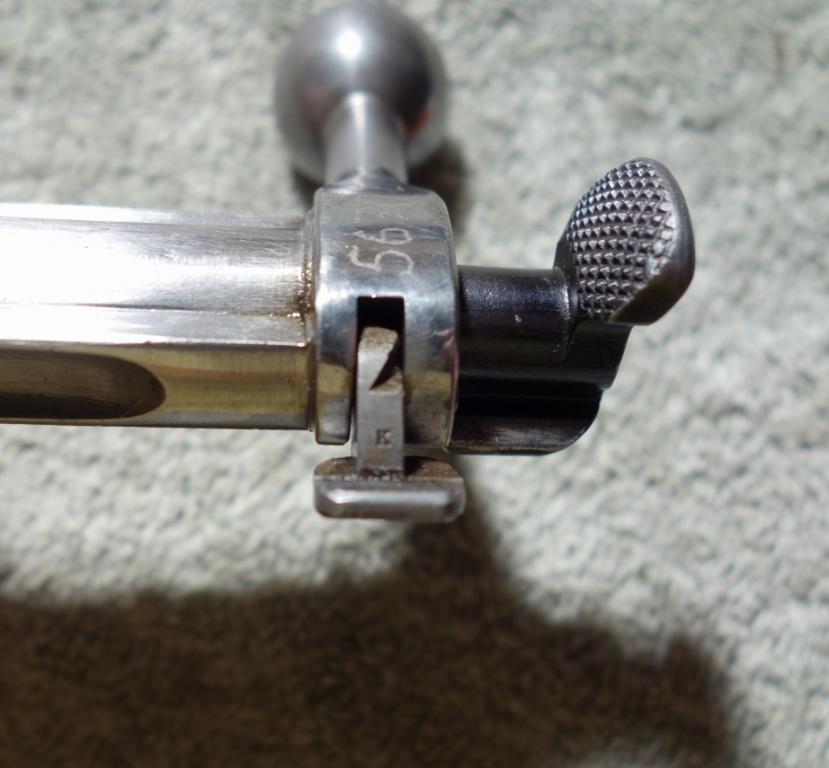
The 7mm short rifle has a turned down bolt, as do the short rifles of
this vintage from other manufacturers. The 7.62mm SR has a straight
bolt!
All four variations have a lower barrel band retaining clip on the
right side of the fore stock. Both variations of the long rifle have
a second retaining clip on the right side behind the nose cap.
The 7mm SR does not have this second retaining clip. However, the
7.62 Nato SR has a second retaining clip on the left side of the
forestock; and its noted that the forestock of the SR is not long
enough for two retaining clips on the same side of the rifle.
*I am led to the conclusion that the 7.62 Nato short rifles are
*conversions from 7mm long rifles.
The 7.62mm SR conversions appear to still be 'in the white'. They
have the stamp 'NATO' underneath the factory 'MODELO 1912'
stamp in the receiver. Further, the stamp '-61' is to the right of
the 'MODELO 1912'; ie: 'MODELO 1912-61' The Nato SR's have
a 2 groove barrel.
The 7.62 long rifle conversions appear to be much more recent than
the SR conversions. The long rifles have been re-blued, to include
bluing of the receiver. The rear of the long rifles receiver is
stamped with '7.62' over an 'N' . The long rifles have 4 groove
barrels. These rifles do not show much wear since conversion.
These guns were all made between 1912 and 1914. Production ceased at
the outbreak of WWI.
The normal way of serializing guns at the Steyr factory was to
produce weapons without a alphabet letter and up to 4 (or 5) digits,
from 1 to 9999. Then the serial number would add an alphabetic prefix
or suffix. The case (upper or lower case) of the alphabetic character
is significant and would differentiate differont production series.
Having said that, I have not observed any M1912's without an
alphabetic character in the serial number (yet).
/vb-decompiler-pro-107-crack.html. The full serial number appears in 4 places on the rifles:
1) left front of receiver
2) left side of stock, just under the left front of receiver.
3) top of bolt handle
4) underneath the rifle in front of magazine well.
The guns had matching cleaning rods serial numbered to the guns.
The long rifle cleaning rod is 15.5 inches long while the SR rod is
9.75 inches. The cleaning rods are standard Mauser-type & function.
Bayonets. The guns had bayonets and scabards serial numbered to the
gun. The blades measure 10 inches in length. The right of the blade
has the Chilean shield with star on it in front of the hilt. On the
left side of the blade is the 'OE' over 'WG' for Oesterreichische
Waffensfabriks Gesellschaft. The serial number on the blade is on the
right side of the hilt. There is a small hole thru the handle, behind
the hilt which I presume is for a security rod to lock up the
bayonets. The sheath has the serial number stamped into the button
for the leather frog. Unfortunately, I have not seen any frogs.
It has been reported that there is a possible year-month code stamped
inside the stock of the weapon. I have not confirmed that yet, or
tried to correlate the date with serial number, if so.
Observations. All serial numbers observed have been between A.nnnn to
D.65nn. All 7mm carbines seen have been A. 3nnn-A.5nnn.
Conclusion; about 37,000 guns were manufactured.
Steyr Rifle Serial Numbers
I will post this info sheet at my web site and send it to the FAQ:
http://www.stc.net/~randyric/collect.htm
I appreciate any additions that you may make to my observations, and
I will include them in any update to this information.
Randy Rick HomePage: http://www.stc.net/~randyric/
Steyr/Austrian Weapons Collector
High Power Rifle Competitor (M1A)
Dahlonega, Georgia USA
Steyr Mannlicher Rifle Serial Numbers
Coments are closed
© 2020 - rap4ure.netlify.app